
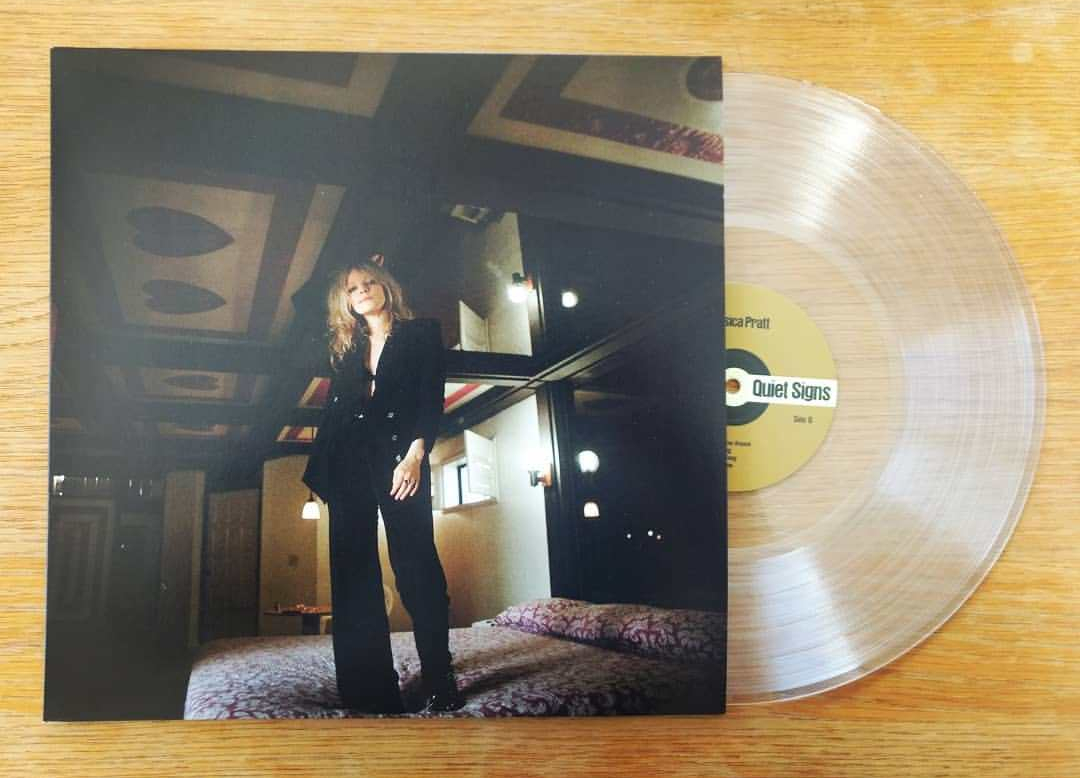
By Allesandro Rotondi
Jessica Pratt has one of the most unique singing voices I’ve ever heard. Quiet Signs is her third album effort, and running at 27 minutes, it is a brief but welcoming glimpse into the philosophical mind of an enigmatic soul. She comes off as delicate and raw, but well-informed about everything she sings about. Pratt’s music is like an all-seeing eye on the world, peeking around every corner and offering insight about what it has seen. Her sound embodies modern folk, even though she doesn’t like the idea of being pinned to any genre. There is no pinning here, however—Quiet Signs is a folk adventure with melded elements of psychedelia and electronic music. What’s brilliant about her, is the way she builds a track upon these styles, with the minimal amount of instruments. In “Fare Thee Well,” Pratt’s bedtrack is straight comping acoustic guitar, with lead vocal and light backing vocals on the upper harmony. But built upon that foundation, however, is a single-note organ, mellotron staccato (or, quickly struck) chords, and at the end, a crooning flute part. These elements are what sets the mood for Pratt’s thinly textured, but aesthetically rich sound throughout the whole album.
Pratt and her producer Al Carlson clearly know how to create an atmosphere that perfectly suits the desires of her music. Upon first listen, I thought her voice was tampered with in post production to give it that wistfully light tone, and the unique style in which she melds words together when she sings. I figured she had sped the tape down, recorded her vocals, and then sped it back to normal speed to pitch her voice up with it. This was especially true after hearing her speaking voice on a KEXP performance, which I thought was surprisingly different than her singing voice. But alas, that is her real voice, and a beautiful one at that. Her light vocals sway, climb, and fall, with the innocence of a young child, and the consoling wisdom of a grandmother. The album’s weightless feeling is largely attributed to there being no bass or bottom end instruments at any point, besides the piano on “Opening Night” and “Crossing.” Her guitar playing crackles like feet on top of autumn leaves, like her almost fizzling strumming on “Here My Love.”
Much more than on her previous two albums, Pratt employs artificial (or perhaps, authentic) tape hiss and reverb to her instruments and vocals, greatly influencing the breezy, and open-chambered feeling that this album possesses. It’s almost as though without your full attention, the music and contour could simply drift away with the wind. Her guitar has a chorus effect on it during many of the tracks, which slightly detunes the sound of the guitar with itself, giving it an electromagnetic wavy feel, reminiscent of a Mac DeMarco record. Pratt’s instrumental palette also consists of woodwinds like lilting flutes, synthesizers like mellotron and organ, synthesized orchestral strings, piano, tambourine, and reverb-drenched vocals and guitar to top it off. Pratt tastefully picks which instruments will best suit the song, and never has more than three or four accompanying her vocals at a time. Her chord choices favour major and minor sevenths, likely the most open sounding and dreamy chord choices any folk guitarist could desire. This is especially true on “Poly Blue,” one of the catchiest and most heartfelt tunes on the album, with melodies and hooks that are likely to follow you everywhere you go. The songs’ keys are more often major than minor, but her chord choices often allude to minor, and the musical expressions profess an often somber feeling. As a songwriter, it’s a difficult task to make a major keyed song sound minor, and vice versa, like Pratt does on “Silent Song.”
This is her first album recorded outside of her home and in an authentic studio, and it also sounds the least like it. More than previously, Pratt’s production style feels like lo-fi, analog, underground folk. However, it’s clearly intentional, and Pratt has learned a thing or two over the years about how to set her words, chords, and melodies, into an atmosphere that provides the most comfortable walls for them to live within. Though Pratt has a wide range of influences, like 1970’s Marianne Faithfull and John Martyn, her musical execution personally reminds me of Paul Simon’s Songbook album, or something K.K. Slider would sing in the coffeeshops of the Animal Crossing game series. Her music also wouldn’t be out of place in the season two soundtrack of The End of the F***ing World (your move, Netflix).
Though Pratt hails from Los Angeles, her music is less reflective of California’s sunny ideals, as so often portrayed by pop culture, and sounds more like Pratt singing around a campfire after sunset, as the wind lightly blows the pacific ocean waves onto the darkened sandy shores. A quiet reflection, almost. I feel comforted by her music, in a melancholic way that is difficult to pinpoint. Pratt addresses issues and hardships that one has to face in their lifetime, but in doing so, assures the listener that when it’s all said in done, everything will be okay. In “Poly Blue,” Pratt sings “Please understand the changes that a boy has had to climb / For what in time, leaves him always late to fly,” assuring the listener that though the subject’s metaphorical flight is delayed, he still flies nonetheless. She made me feel better about things I wasn’t actually concerned about before I heard the record, but left me with the sensation of new experiences and adventures. I feel a little bit more out of my shell after having listened to Quiet Signs. My introduction to Jessica Pratt’s music has been a pleasant one, and like a new friend that pulls your arm onward to new adventures and places, I can’t wait to see what happens next.
 Notes on Notes