
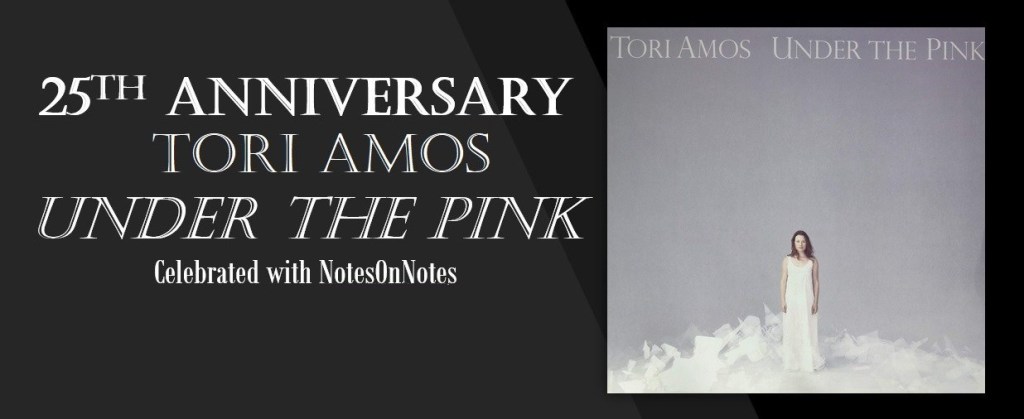
The 90’s birthed third-wave feminism and mothered an array of badass female artists who decided to raise eyebrows and sing about some not-so-radio-friendly subjects. Tori Amos was undoubtedly, queen of the badasses. A prodigy with a piano. A sagacious lyricist. Accepted into the Peabody Conservatory of Music in Baltimore at age five, Amos was destined to have an unprecedented career in music. The singer/songwriter has been releasing albums since the late 80’s and shows no sign of stopping now well in her 50’s. Her alt-pop-rock sound is the perfect vehicle for forwarding her political agenda, which has been clear since she started releasing music.
The 90’s were a rich decade of musical rebellion, and Amos was happy to take part. No stranger to resistance, she actually fought her label to take on the kind of music style that she’s so well known for, ditching their proposal for an 80’s rock persona after her first album, Y Kant Tori Read, bombed.
One might ask where does all power and strength come from?
After being kidnapped, held at gunpoint, and raped when she was twenty-one, Amos knew she had to do something to help other survivors. Her first solo album was a very much needed therapy session for her and for the women who came out to see her on her 250-city tour for Little Earthquakes. Most notably, however, is that in 1994 Amos co-founded RAINN, (Rape, Abuse, and Incest National Network) which is a helpline for sexual assault victims. Now that Amos had succeeded in helping others with her first album and new hotline, she continued her own healing process with her next album Under the Pink, which released in 1994.
In an interview with The Boston Globe in January of 1994, Amos described her process of working on her trauma through her music saying, “I have to somehow find the tools to get in there and realize that I have a choice on whether I want to be a victim for the rest of
my life…I do it through the songs…These are the tools I use. Music tools.”
Under the Pink is an unbelievably humane album that represents the realities of womanhood. There’s depth and overlap of uncomfortable realities, and Under the Pink is revolutionary in its rejection of the idea that women are these idealistic, non-sexual embodiments of perfection. Women masturbate, women question their religious upbringing, women are abused, women are assaulted. Amos layers and packs in these controversial issues, as if saying “why are these issues stigmatized? Why are we not talking about these things? If no one else will, I will”. And in Under the Pink, she does.
More than anything, Amos wanted to go her own way with music instead of competing her with contemporaries. With each song on the album, Amos felt that she needed to explain each song, track by track as each track has a character that represents each one of the controversial topics she confronts. There is women being betrayed by other women, sexual indulgences, and conflicts in religion. It is all mended together to create a feminine purity of social and sexual freedom.
However, this leaves us wondering…. What about the amazing instrumentation that accompanies her beautiful pure vocals and the narration in her music? On one note, Amos started to play with new ways to not only emphasize her amazing lyrics, but make sure the sounds that supported them touched the souls of the women she wanted to reach.
In “God”, Amos uses funky guitars, bass, and drums, with sizzling rhythms from Brazilian percussionist Paulinho da Costa. It is worth noting that during the sessions for Under the Pink, Amos was collaborating instrumentally with jazz, funk, and R&B studio musicians from the 70’s and 80’s. This was a pretty far cry from the grunge sound of the day, and the makeup of instrumental and genre variation speaks to this. For instance, check out “Space Dog” for a look into Amos’ classical piano, in fusion with jazz, funk and R&B. In “God”, Amos also employs odd time changes, adding sudden bars of 3/4 time that throw off the constant 4/4 time signature of the rest of the song. This break of rhythmic inconsistency is likely a musical interpretation by Amos to prove to listeners that sometimes God just doesn’t come through. What’s also important is that it’s not so much the consistency and energies of God she’s confronting, but the institution of God that will do wrong or bad things in His name. Lyrically, the topic is quite heavy, but the thick texture of instrumentation and various genre styles provide a good supporting foundation for the song’s verbal message.
Then there’s “Past the Mission”, which also deals with the issues of religion. Like “God”, this song is accompanied with instruments, unorthodox for 1994, like the Vox Organ, and piano with styrofoam being pushed on the strings to create, according to Amos, the “strange bassoon sound”. Trent Reznor, known by stage name Nine Inch Nails, provides backing vocals and male vocal-doubling during the chorus, ultimately adding to the groovy funk/rock sound that the song portrays. In an interview with The Baltimore Sun in 1994, Amos states that this song explores the relationship between Jesus and Mary Magdalene, which Amos believes were a couple: “She represents the Goddess, the female, the feminine, the joining, the equality… until we have mutual respect, there’s that prison tower, and there’s that mission (church), and the hot girl got lost somewhere in between”. It seems that this song is the attempt to find Magdalene and restore the Church to the equality it should stand for.
If we thought these two songs were radical in relation to religion, Amos touches more unforbidden grounds with “Icicle”. There’s something grand about the instruments in this song, almost as if you’ve gone to the orchestra or symphony as a long piano instrumental sets the tone of something beautiful to follow. Yet, the lyrics Amos sings is a stark contrast with the feeling. Nonetheless she melts the two together beautifully, which is hard to do with a song about female masturbation.
“Icicle” literally intertwines the topic of female masturbation with prayer: “And when they say take of his body/ I think I’ll take from mine instead”. Did Amos just reject the eucharist in favour of masturbating? Uh hell YES she did! If this isn’t having guts, I don’t know what is. By doing so, she gives power back to women of the Church who essentially have none compared to their male counterparts.
“I tell of how I used to masturbate at home as a teenager, while my father and his fellow theologians were downstairs discussing the Divine Light. I was exploring the ‘divine light’ within myself… when I say I want to “do it” with Jesus Christ it’s not just that I want to sexualise Jesus, bring him down to our level, I want to breathe the earth into his lungs. He came from Heaven and we, as women, come from the earth. So it’s the idea of soil beneath the fingers.” —Hot Press, February 1994
As much as this song is about masturbation, it’s also about connecting with Jesus on a more interpersonal level. While the Church restricts female lust and expression, Amos argues that it is in this way that we can connect with the Saviour ourselves, uniting Heaven and Earth.
Evidently, Amos believes in unity and equality in all things. While doing an interview with Amos, journalist Ann Powers from The Record noticed that Amos invokes the four elements (Earth, Water, Air, and Fire) on the nights before her show. This is done to remind everyone that music, metaphorically speaking, is a gesture to thank the four elements. Earth — skillful and solid, Water — responsive and adaptive, Air — imaginative, and Fire — passionate. Thus, Amos’ music can be understood in elemental terms. She merely works as the container, surrendering herself to the energies of the world while at the same time remaining grounded in it. Amos then send this positive energy to her audience which in turn sends it back, ultimately creating spiritual bonds with her audience as “He came from Heaven and we, as women, come from the earth”. By accepting the energies of the Earth while still celebrating the energy of Christ, Amos is able to connect with both God and her audience on a level that is all inclusive.
In “Bells for Her”, Amos uses a prepared piano to accompany her vocals, essentially placing items on the strings to alter the sound, like the styrofoam piano on “God”. This technique was used to make the piano sound more like a celeste (think of the Harry Potter theme), or a music box. It is as if the audience is being pulled into this music box that is filled with memories, since it deals with the end of a friendship. Similarly, “Cloud on My Tongue” deals with the end of a relationship as well, but this time in the form of a breakup. The two songs sound remarkably similar as both use minimal instrumental dynamic—piano and vocals. While both mimic the sadness felt within the songs, there’s something deeply sorrowful felt in “Bells for Her”. Here, the character sees that her friend has “her face and her eyes/ But you are not her”. Her appearance may be the same, but she is no longer the friend she used to be. There’s this deep and desperate longing for her friend to return to her, while in “Cloud on My Tongue” the character blatantly tells her ex that “you can go now”. Although it pains this character to be in a constant whirlwind of emotions with her ex, it definitely pains her more to grow up and only recognize the shell of her childhood friend.
What really makes Tori Amos a shining star is that by 1999, the album had graced the CD players of two million Americans, earning it a double Platinum certification. Twenty-five years following it’s ’94 release, it’s clear that Amos was among the many female artists who helped to pave a path for present day female artists. Kesha for example, released her 2017 song “Praying” which intertwines religious themes while addressing her sexual abuser. A year later, artist Ariana Grande released her bold and controversial song “God is a Woman” which centers around female sexuality and empowerment. Songs like these—although still found to be controversial and taboo by some—in their mere existence show that albums like Under the Pink have sparked an insurgence of strong female artists continuing to resist against the silence of conforming to an image of idealized female perfection. Under the Pink is a rejection of the perfection and has influenced the music world by showing women that they’re allowed to show their layers: the good, the bad, and the ugly. Without Amos in the music world, women and beautiful instrumentation would be lost “under the pink”. Amos knocks down the concrete wall and levitates women, piano keys, and feminine prosperity into a light that has influenced many emerging female artists today.
Amos’s newest album Native Invader (2017) shows her strong rebellious spirit has not dulled with age, as she tackles other current issues coming to light. Her affinity for the earth and elements is highlighted in Native Invader, where Amos focuses her energies on the injustices done to Indigenous peoples and speaks to environmental issues which are becoming ever more prevalent in society today. Amos shows her compassionate soul and talent by giving a voice to the voiceless in each of her albums. She stood up for herself, and women in Under the Pink, and twenty-five years later she is still standing up for others. Amos’s music has grown as she has grown, and only expanded in breadth and capacity with time.
As it is the 25th anniversary since Under the Pink has debuted, NotesOnNotes wants everyone to raise a glass and cheers to Tori Amos, for her badass attitude and her lighting the way in the music industry and into people’s hearts.
 Notes on Notes